
A Short History of Bangkok, Thailand
The city of Bangkok, with its stunning temples, bustling streets, and rich cultural heritage, has been the capital of Thailand for over two centuries. But have you ever wondered how this magnificent metropolis rose to prominence? So, we look over our shoulders, and take a journey through time, to explore a deeper-than-the-average-tourist’s knowledge, on the history of Bangkok’s ascension as the capital city of Thailand. Bangkok, a dazzling city that has served as the capital of Thailand for more than two centuries, is known for its awe-inspiring temples, vibrant streets, and a rich cultural heritage, that is steeped in history. This magnificent metropolis, which is a blend of the old and the new, has a fascinating history that traces its journey to becoming the capital city of Thailand.
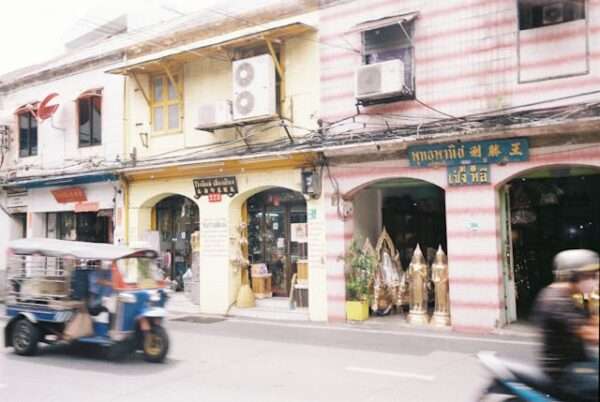
The city’s ascension to prominence is a captivating tale that takes us through time. Bangkok’s strategic location, coupled with its unique charm, played a significant role in its rise. The city’s stunning temples, which are a testament to its deep-rooted religious heritage, have been drawing visitors for centuries. The bustling streets, on the other hand, are a testament to the city’s commercial prowess. Exploring the history of Bangkok’s rise is like discovering a treasure trove of stories, that are as diverse, as they are intriguing. From its humble beginnings as a small trading center, to its transformation into a thriving metropolis, Bangkok’s journey through time, is an essential study of how ancient South-East Asian Kingdoms, and a Capital city can evolve and flourish.
The Early Days: Ayutthaya (1350-1767)
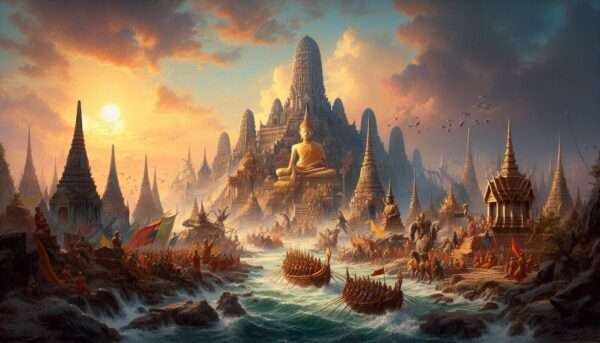
Before becoming the capital, Bangkok was just one of many cities in the kingdom of Siam. The true birthplace of Thai culture and politics was Ayutthaya, a majestic city located about 80 kilometers north of modern-day Bangkok. Founded by King Ramathibodi I (also known as Phra Ruang) in 1350, Ayutthaya grew into a powerful and prosperous kingdom, with its capital serving as the center of trade, commerce, and politics. During this period, Ayutthaya was a major hub for Buddhist learning, art, and architecture. The city’s iconic temples, such as Wat Phra Si Sanphet and Wat Mahathat, showcased the grandeur and beauty of Thai artistry. However, despite its prosperity, Ayutthaya faced numerous threats from neighboring kingdoms, including the Burmese Empire.
The Fall of Ayutthaya (1767)
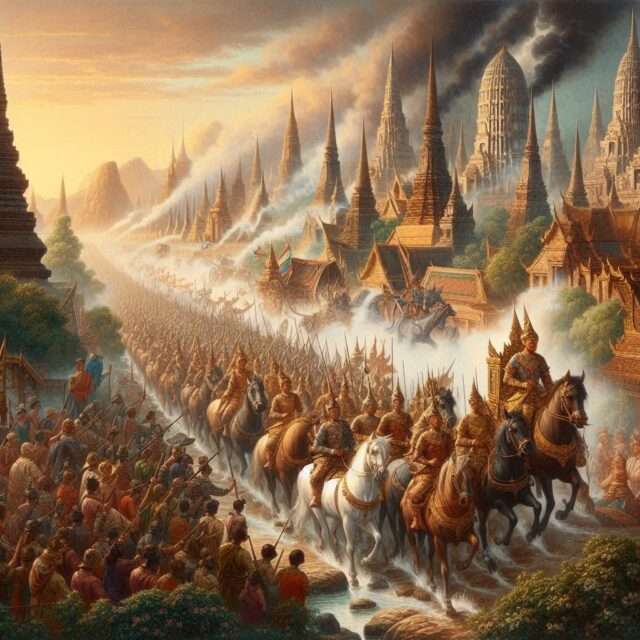
In 1767, a massive Burmese army marched towards Ayutthaya, led by King Hsinbyushin of Burma. After a lengthy siege, the Burmese breached the city walls and destroyed much of Ayutthaya. The once-mighty capital lay in ruins, its people either captured or forced to flee.
The Rise of Thonburi (1768-1782)
Following the fall of Ayutthaya, a group of survivors led by King Taksin, also known as Thaksin, established a new capital at Thonburi. Located on the west bank of the Chao Phraya River, opposite modern-day Bangkok, Thonburi became a temporary capital for about 14 years.
During this period, King Taksin implemented various reforms to strengthen Siam’s military and economy. He also introduced the “Royal Barge Ceremony,” an annual celebration still held today, which showcases Thailand’s rich cultural heritage. However, King Taksin’s reign was short-lived, as he faced growing opposition from other factions within the kingdom.
The Founding of Bangkok (1782)
In 1782, a coalition of nobles led by General Chakri, who later became King Rama I, overthrew King Taksin, and established a new capital at Bangkok. The city’s strategic location on the east bank of the Chao Phraya River, with its fertile soil and access to the sea, made it an ideal site for a new capital.
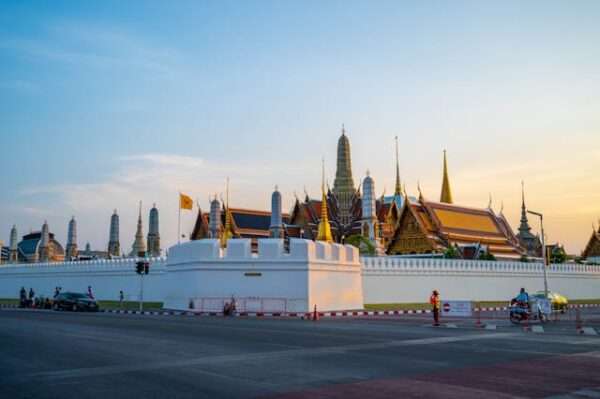
King Rama I, also known as Phra Buddha Yodfa Chulaloke, laid the foundation for modern-day Thailand by introducing various reforms, including the creation of a more centralized government, a reorganization of the army, and the establishment of the Grand Palace. He also built many temples, such as Wat Pho, which has become one of Bangkok’s most iconic landmarks.
The Growth of Bangkok (18th-19th Centuries)
Under the rule of successive kings from the Chakri dynasty – Rama II, Rama III, and Rama IV – Bangkok continued to expand and flourish. The city became a major hub for international trade, with merchants from across Asia, Europe, and America coming to do business in its ports. Under the rule of successive kings from the Chakri dynasty Rama II, Rama III, and Rama IV Bangkok continued to expand and flourish. The city became a major hub for international trade, with merchants from across Asia, Europe, and America coming to do business in its ports.
However, it was King Rama V (Chulalongkorn), who ruled from 1868 to 1910, who implemented many significant reforms that modernized Bangkok and transformed the city into a cosmopolitan metropolis. One of his most notable achievements was the introduction of Western education and technology. He sent Thai students abroad to study in Europe and America, where they were exposed to new ideas and technologies.
King Rama V also introduced the concept of a modern bureaucracy, with a clear chain of command and a standardized system of administration. He reorganized the government, establishing ministries and departments that were responsible for various aspects of governance, such as finance, education, and public works. The king’s efforts to modernize Bangkok led to significant improvements in infrastructure, including the construction of roads, canals, and bridges. He also established a new system of transportation, introducing steam-powered boats and trains that connected Bangkok with other parts of the country.
In addition to these reforms, King Rama V was a strong advocate for women’s rights and education. He introduced laws that allowed women to own property and participate in business, and he opened up new
educational opportunities for them. Under his rule, Bangkok underwent rapid modernization, transforming from a humble village into a cosmopolitan metropolis. The city became known for its vibrant cultural scene, with the introduction of Western music, theater, and art forms. The king also encouraged the development of Thai literature and culture, establishing institutions such as the Siam Society to promote learning and intellectual pursuits.
King Rama V’s legacy is still visible today in Bangkok’s architecture, art, and culture. His modernization efforts laid the foundation for the city’s continued growth and development, and his commitment to education and social reform paved the way for Thailand’s emergence as a modern nation-state. The 19th century saw significant improvements in infrastructure, including the construction of roads, canals, and bridges. The introduction of Western education and technology also brought about changes in Bangkok’s architecture, art, and culture. During this period, the city underwent rapid modernization, transforming from a humble village to a cosmopolitan metropolis.
The Golden Age (1910s-1940s)
In the early 20th century, Bangkok entered its golden age under the rule of King Rama VI (Vajiravudh) and later his brother, King Rama VII (Prajadhipok). This period saw significant economic growth, urban development, and cultural flowering. The city became a center for modern arts, with influential artists like Silpa Bhirasri creating innovative works that blended traditional Thai styles with Western techniques.
The Modern Era (1950s-Present)
In the second half of the 20th century, Bangkok continued to grow and evolve. The country experienced rapid economic growth during the Cold War era, with Thailand emerging as a major player in regional politics and trade. In 1975, King Bhumibol Adulyadej (Rama IX) took the throne, marking the beginning of the current constitutional monarchy.
Today, Bangkok is one of Asia’s most vibrant cities, with over 8 million inhabitants and an economy driven by tourism, manufacturing, and finance. Its rich cultural heritage continues to thrive, with numerous festivals, markets, and landmarks celebrating Thai traditions. From its humble beginnings as a small trading post to its current status as the capital city of Thailand, Bangkok has undergone a remarkable transformation over the centuries. This journey was marked by periods of turmoil, innovation, and growth, which ultimately shaped the city into what it is today – a fascinating blend of ancient traditions and modern progress.

As we explore the streets of Bangkok, it’s essential to remember the people who came before us – from King Ramathibodi I, who founded Ayutthaya, to King Rama IX, who ruled during the country’s modern era. Each of their contributions has helped forge the unique identity that defines this magnificent city. Bangkok’s story serves as a testament to Thailand’s resilience and adaptability in the face of adversity. As we walk through its crowded streets, marvel at its stunning temples, or haggle for souvenirs at Chatuchak Market, let us appreciate the complexities and layers of history that have created this magnificent city – Bangkok, the capital of Thailand.
