Watch the Full Widescreen Video Documentary
Spoken Documentary Narration by Ajarn Spencer Littlewood
History rarely repeats itself as an exact mirror, yet anyone who studies the architecture of power across nine centuries begins to recognize the same skeletal geometry beneath wildly different banners. We are taught to view medieval religious warfare, esoteric fraternal orders, twentieth-century systems modeling, and twenty-first-century coastal redevelopment as sealed compartments belonging to separate centuries. When you place them side by side on a single table, however, an unsettling continuity emerges around three enduring mechanisms of control—sacred legitimacy, transnational financial networks, and the mastery of maritime corridors.
The Crusades and the Twin Pillars of Medieval Power
Between the eleventh and thirteenth centuries, Western Christendom launched the Crusades to wrest the Holy Land from Muslim sovereignty, generating national mythologies and tales of martial chivalry that still echo in modern political rhetoric. Beginning with the Council of Clermont and unfolding through the People’s Crusade and the Princes’ Crusade, the early wave established Latin footholds along the Levantine coast through the Crusade of 1101, Bohemond’s campaign, the Venetian Crusade, and the expedition of 1129. Subsequent centuries saw cyclical collapses and desperate recoveries across the Second and Third Crusades, the Crusade of 1197 that birthed the Teutonic Knights, the Fourth through Sixth Crusades, and the Barons’ Crusade, before the Seventh, Eighth, and final expeditions collided with Mamluk armies, Mongol incursions, and Ghibelline rivalries.
Crusading warfare did not even stop at the borders of Palestine; campaigns continued across Iberia against the Emirate of Granada until 1492, while the Teutonic Order waged prolonged anti-pagan wars across the Baltic through the 1410s. Unsurprisingly, modern Muslim historians, thinkers, and statesmen have repeatedly drawn direct historical parallels between those medieval expeditions and contemporary Western and Israeli interventions following the establishment of the State of Israel in 1948.
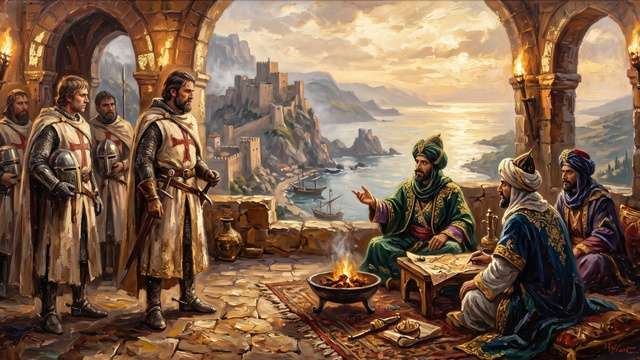
Out of this cauldron stepped two extraordinary orders whose real historical footprint has fueled centuries of esoteric legend. Founded around 1119 CE as the ‘Poor Fellow-Soldiers of Christ and of the Temple of Solomon’, the Knights Templar began by guarding Christian pilgrims traversing hostile roads. Within generations, their immunity, discipline, and trans-border fortifications turned them into Europe’s earliest transnational banking network—an institution of such financial reach that modern conspiracy literature, under the label ‘Poor Knights of the Templars’, still lists them inside the ‘Committee of 300’. Their ascent ended abruptly when the Crusader States collapsed, leading Pope Clement V to disband the order in 1312 and Jacques de Molay to meet the stake in 1314.
Across the Syrian and Persian mountains operated their supposed ideological opposites, the ‘Hashishin’—the Nizari Ismaili order founded by Hassan-i Sabbah, infamous across the Middle Ages for precision political assassination. Popular imagination pits Christian knight against Persian assassin in eternal holy war, yet historical accounts document a far stranger truth—in real life, the Templars and the Assassins forged tactical alliances whenever pragmatism outweighed dogma.
The Club of Rome and the Geometry of Ten Kingdoms
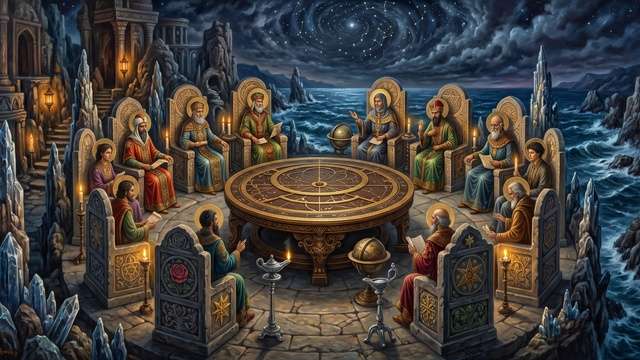
Jump forward from medieval fortress diplomacy to 1973 and 1974, when the Club of Rome—an elite global assembly of scientists, economists, and statesmen—published Mankind at the Turning Point and unveiled a geopolitical blueprint dividing the planet into ten integrated regional blocs. Intended on paper as a rational architecture for sustainable governance against overpopulation, resource depletion, economic volatility, and ecological strain, those ten regions quickly acquired the popular moniker of the ‘Ten Kingdoms’.
Once a technical diagram mirrors an ancient prophetic archetype, human consciousness bridges the gap immediately. Christian eschatologists immediately matched the Club of Rome’s map against Revelation 17 verses 12 through 14, which warn of ten kings without a kingdom receiving authority for one hour alongside ‘the beast’, uniting their power under centralized dominion. Geopolitical historians pointed even further back to the tenth century BCE, when Solomon’s united monarchy fractured into the Northern Kingdom of Israel—comprising ten tribes later swept away by the Neo-Assyrian Empire around 722 BCE into the legend of the Ten Lost Tribes—and the Southern Kingdom of Judah and Benjamin.
Today, three competing lenses compete to decode that map. The pragmatic view treats continental blocs as an inevitable administrative response to complex planetary bottlenecks; the conspiratorial reading sees a deliberate oligarchic design for centralized surveillance and eroded autonomy; and the prophetic lens views the map as sacred scripture unfolding on schedule. Yet perhaps the deepest insight lies in recognizing a structural pattern—under acute systemic pressure, large human networks repeatedly self-organize into hierarchical regional blocs whether designed by secret cabals or emergent geopolitics.
From the Balfour Declaration to Partition and Displacement
Nowhere do medieval memory, imperial cartography, and modern power politics converge more violently than along the eastern Mediterranean coast. The legal foundation for modern conflict began with the 1917 Balfour Declaration, through which the British Government pledged support during the First World War for establishing a ‘national home for the Jewish people’ in an Ottoman province where Jewish inhabitants were then a small minority. The British Mandate of Palestine took effect in 1920, locking Arab, Jewish, and British forces into decades of escalating confrontation.
Following the United Nations Partition Plan of November 1947 under Resolution 181—which proposed splitting the land into Jewish and Arab states alongside an internationally administered corpus separatum for Jerusalem and Bethlehem—full-scale civil war erupted the very next day. Arab nations rejected the partition outright, and when the State of Israel declared independence on May 14, 1948, four neighboring Arab armies entered the war after the Arab League denounced the partition as aggression. By the 1949 Armistice Agreements that etched the Green Line into the map, Israeli forces held roughly seventy-eight percent of the former Mandate, Jordan held East Jerusalem and the West Bank, Egypt administered the Gaza Strip, the promised Palestinian state never materialized, and more than seven hundred thousand Palestinians fled or were expelled in what Palestinians commemorate as ‘Al-Nakba’—the Catastrophe.
Decades later, the waves of the Arab Spring starting in Tunisia demonstrated how mass civic uprisings could topple entrenched rulers across Egypt and Libya, yet the core territorial and maritime questions of the Levant remained unresolved—setting the stage for something far more calculated than spontaneous revolution.

Sea Chokepoints and the Demolish Before Construction Thesis
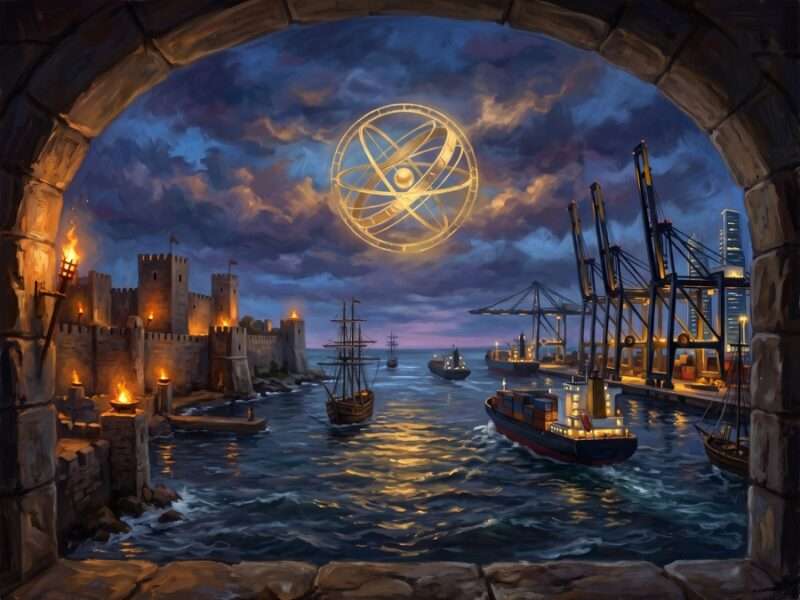
To grasp what happens after widespread wartime ruin, you have to abandon sentimental narratives and look strictly at maritime logistics. Nearly all global trade and energy flows through narrow maritime arteries called chokepoints. Whoever commands ports along those straits commands sovereign leverage over nations. When conflict effectively choked the Strait of Hormuz, global oil and gas prices spiked overnight while commercial shipping detoured thousands of miles. Consider the twenty-two point eight billion dollar transaction in which Hong Kong conglomerate CK Hutchison, facing intense geopolitical pressure over strategic ports straddling the Panama Canal, sold controlling stakes to a consortium led by American investment titan BlackRock—a deal celebrated in Washington as a strategic victory along a decisive global waterway.
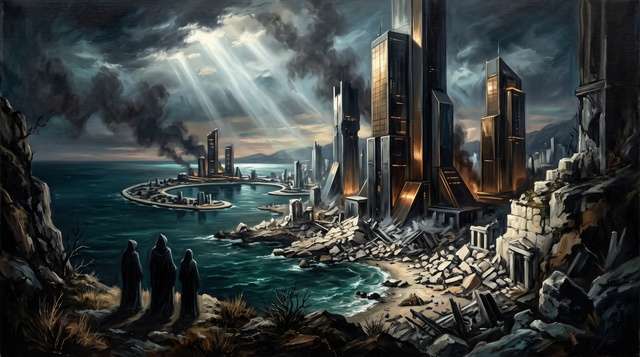
Seen through that lens, the staggering post-2023 devastation in Gaza—requiring up to fifty billion dollars in UN-estimated reconstruction—looks less like blind collateral damage and more like what analysts call a ‘demolish before construction’ strategy. Clearing dense urban populations and legacy infrastructure converts contested land into a blank architectural ledger for high-yield real estate and Mediterranean trade security.
Across leaked prospectuses and state think tanks, the blueprints are remarkably explicit. Alongside Israel’s ‘Gaza 2035’ framework, the Vandenberg Coalition and JINSA’s ‘Gaza Futures Taskforce’, and the RAND Corporation’s peace pathways, the U.S. administration’s thirty-eight-page ‘GREAT Trust’ prospectus leaked in August 2025 sketches a high-tech coastal transformation financed heavily by Saudi Arabia, the United Arab Emirates, and Qatar—subject to strict political preconditions dismantling Hamas rule and framing future governance. Those plans envision a ‘Gaza Riviera’ and ‘Trump Touristic Riviera and Islands’ featuring artificial islands modeled on Dubai’s Palm developments, luxury resorts, golf courses, an expanded Al-Arish corridor, a new Dahaniya airport, and a functioning deep-water roll-on/roll-off coastal port.
No dedicated Western naval base needs to be inked onto the brochure when the strategic dividends already speak plainly—anchoring Western leverage in the Eastern Mediterranean, accelerating the India-Middle East-Europe Economic Corridor known as IMEC, and securing industrial pipelines to Gulf rare-earth minerals. Beneath it all sits a proposed security architecture backed by Western Private Military Contractors under a U.S.-led trusteeship projected at twelve point nine billion dollars over ten years, recasting state power as urban developer, digital custodian, and population manager. From medieval knights guarding coastal trade and pilgrim routes to modern financial consortia redesigning demolished shorelines, the emblems on the banners change while the underlying mechanics of maritime empire endure.
Author; Ajarn Spencer Littlewood
Homepage: www.ajarnspencer.com
Related Publications and Digital Books from the Archive
Explore our in-depth digital books, esoteric monographs, and audio-visual explainer sets available directly in the Ajarn Spencer Publications Archive, examining urban control architectures, artificial intelligence conditioning, sacred Thai sorcery, and meditative practice.
-

Travelers in Time E-book and Audio Podcast Explainer Set
฿100.00 Add to cart -

Vipassana – A Complete Guide to Applied Practice
฿0.00 Get Free -

Deceptive Chat: Hacking LLMs – Using Natural Language to talk A.I. in Circles By Ajarn Spencer Littlewood
฿99.00 Add to cart -

AI Personality: Inherited Conditioning and Human Influence
฿0.00 Add to cart -
The 15 Minute City
฿0.00 Add to cart -

Sak Yant Ebook and 6 Buddha Magic Issues
฿2,500.00 Add to cart
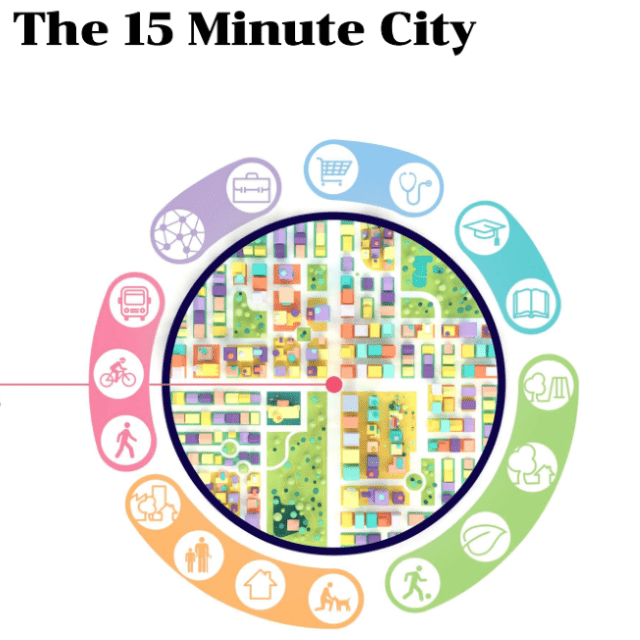
An investigative study of modern technocratic urban zoning, digital surveillance grids, and civic movement architectures.

Travelers in Time E-book and Audio Podcast Explainer Set
Complete e-book and spoken audio exploration of temporal mechanics, causality horizons, and metaphysical cosmology.

Deceptive Chat — Using Natural Language to Talk AI in Circles
Dissecting algorithmic guardrails, synthetic sycophancy, and linguistic leverage inside modern Large Language Models.

AI Personality — Inherited Conditioning and Human Influence
How pre-training corpora, corporate alignment filters, and human projection shape machine personas.

Vipassana — A Complete Guide to Applied Practice
Practical manual on the foundations of insight meditation, mental clarity, and liberation from conditioned illusion.

Sak Yant Ebook and 6 Buddha Magic Issues
The foundational seven-volume compendium on sacred geometry, traditional yantra tattoo lineages, and Siamese esoteric lore.
