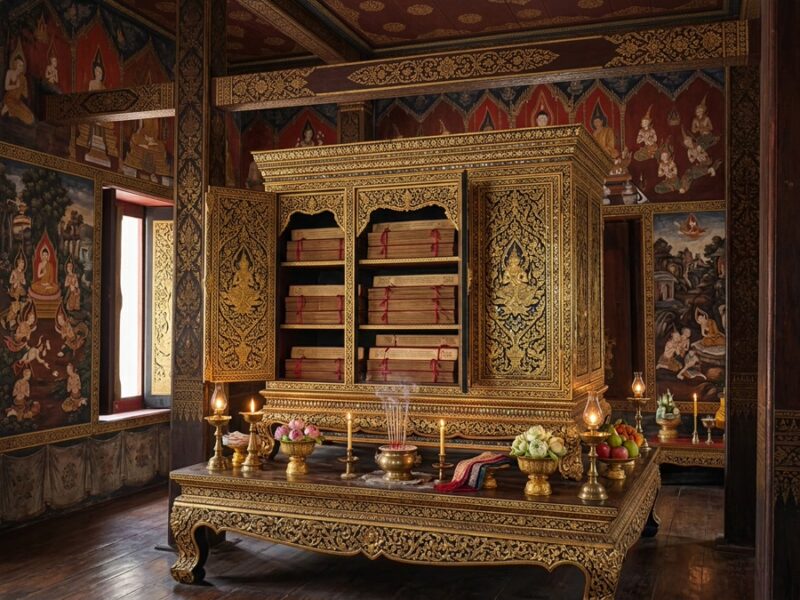
For over two and a half millennia, the spiritual legacy, ethical foundations, and psychological roadmap of Theravāda Buddhism have been preserved within a monumental scriptural canon known in Pāḷi as the Tipiṭaka—literally meaning “The Three Baskets” (from ti, meaning three, and piṭaka, meaning a woven basket or repository of transmission). In the ancient oral traditions of Northern India, woven vessels were used by builders and harvesters to pass earth and produce from one hand to another along an unbroken chain of laborers. In identical fashion, the profound discourses, disciplinary codes, and analytical maps realized by Gautama Buddha were transmitted from teacher to disciple, generation after generation, without losing a single strand of doctrinal integrity.
The canon crystallizes the Buddha’s comprehensive dispensation into three distinct yet deeply symbiotic divisions: the Vinaya Piṭaka (The Basket of Monastic Discipline), the Sutta Piṭaka (The Basket of Discourses), and the Abhidhamma Piṭaka (The Basket of Ultimate Realities). Far from representing dry academic treatises, these Three Baskets map directly onto the foundational Buddhist paradigm of the Threefold Training (Tisikkhā):
- Sīla (Moral Integrity and Ethical Restraint): Codified systematically in the Vinaya Piṭaka as the essential purification of bodily and verbal karma.
- Samādhi (Meditative Absorption and Mental Stability): Expounded dynamically throughout the Sutta Piṭaka across thousands of contextual conversations, parables, and meditative blueprints.
- Paññā (Transcendent Discriminating Wisdom): Dissected with surgical micro-phenomenological precision in the Abhidhamma Piṭaka, penetrating the fleeting elements of mind and matter.
The historical codification of this canon began immediately following the Mahāparinibbāna (the final passing into extinction) of Gautama Buddha around 483 BCE. At the First Buddhist Council convened at the Sattapaṇṇi Cave in Rājagaha, five hundred fully enlightened Arahants gathered under the leadership of the venerable Mahākassapa. In this historic assembly, the Venerable Upāli, the foremost master of legalistic ethics, recited the monastic rules to establish the Vinaya, while the Venerable Ānanda, the Buddha’s personal attendant gifted with photographic memory, recited the universal Dhamma discourses with the venerable preamble, “Evaṃ me sutaṃ”—“Thus have I heard.”
For nearly four centuries, the Dhamma was sustained purely through communal vocal chanting (saṅgīti) by lineages of specialist reciters known as Bhāṇakas. It was not until the first century BCE, amid catastrophic famine and foreign warfare in Sri Lanka during the reign of King Vaṭṭagāmaṇī Abhaya, that the Sangha convened at the Aluvihāra cave temple in Mātale to inscribe the entire Tipiṭaka onto cured talipot palm leaves (ola leaves). This momentous act ensured that even if every living master were to perish, the pristine Dhamma would endure uncorrupted for future eras. In Southeast Asia, and particularly within the borders of Siam (Thailand), the Tipiṭaka attained sovereign veneration, protected in exquisitely gilded lacquer cabinets (Tu Phra Trai Pidok) and meticulously recopied by royal decree, culminating in King Chulalongkorn’s (Rama V) historic publication of the world’s first printed Pāḷi Tipiṭaka in 1893.
The First Basket: The Vinaya Piṭaka (The Basket of Discipline)
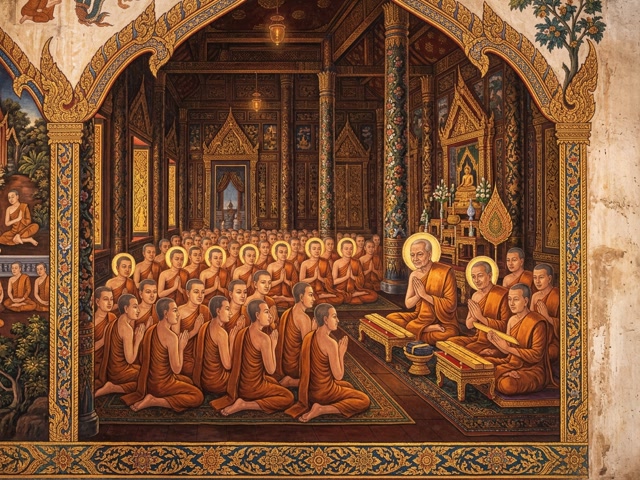
The Vinaya Piṭaka: Codifying the ethical fortress and communal governance of the Sangha in the classical Thai Rattanakosin artistic lineage.
The Vinaya Piṭaka constitutes the practical infrastructure and ethical perimeter of the holy life (Brahmacariya). In the Buddhist view, liberation from the cyclical suffering of saṃsāra cannot occur in an environment of chaotic impulse, moral recklessness, or unresolved social conflict. Ethical purity (Sīla-visuddhi) is the indispensable prerequisite for genuine tranquility and mental stillness. If the mind is agitated by remorse, deceit, or unbridled sensual pursuit, sustained meditative absorption (jhāna) remains utterly inaccessible.
The Vinaya is far more than an arbitrary set of punitive restrictions; it is an organic, compassionate system of communal governance designed to protect the monastic community from moral decay, ensure public trust, and create an optimal social microcosm wherein monks and nuns can cultivate effortless mindfulness. The Vinaya Piṭaka is divided into five primary monumental treatises:
- Pārājika Pāḷi (Major Defeats): This text examines the gravest infractions that entail immediate and irrevocable expulsion from the monastic order, known as the four Pārājikas: engaging in sexual intercourse, stealing items of significant value, intentionally taking human life (or inciting another to suicide), and falsely claiming superhuman spiritual attainments (such as claiming unachieved jhāna or psychic powers for personal gain).
- Pācittiya Pāḷi (Expiable Offenses): This work details the remaining rules of the Bhikkhu Pātimokkha (the 227 rules for monks) and the Bhikkhunī Pātimokkha (the 311 rules for nuns). Each rule is accompanied by its historical origin story (nidāna), detailing the exact comedic or tragic misstep by early disciples that compelled the Buddha to establish the rule, followed by the precise legal phrasing, exceptions, and non-offense clauses. Offenses range from Saṅghādisesa (requiring formal assembly rehabilitation) to minor Pācittiya breaches requiring simple open confession before a fellow monastic.
- Mahāvagga (The Great Division): This monumental legal chronicle outlines the core liturgical and logistical machinery of the Sangha. It records the historical enlightenment of the Buddha, the delivery of the first sermon, the regulations governing formal monastic ordination (Upasampadā), the bi-weekly Uposatha recitation of the Pātimokkha, the observance of the three-month Rains Retreat (Vassa), and detailed provisions for medical treatments, footwear, and the annual offering of the Kathina robe.
- Cullavagga (The Lesser Division): Containing the secondary procedures of monastic life, this book addresses the protocols for settling ecclesiastical disputes (Adhikaraṇa-samatha), the handling of monastic housing and furnishings, personal etiquette, the admission and ordination of the first Buddhist nuns led by Mahāpajāpatī Gotamī, and the definitive historical chronicles of the First and Second Buddhist Councils.
- Parivāra (The Compendium): Attributed to an elder named Dīpa, this final work is a sophisticated pedagogical manual composed in catechism style. It categorizes, cross-indexes, and tests the entire disciplinary code from every imaginable legal angle, functioning as an indispensable reference handbook for monastic judges and preceptors.
For the modern lay practitioner and Vipassanā meditator, the Vinaya serves as an inspiring mirror. While laypeople do not observe the 227 rules of the Pātimokkha, their practice of the Five Precepts (Pañcasīla) or Eight Uposatha Precepts draws its psychological vigor directly from the spirit of the Vinaya. By guarding the doors of bodily action and speech, one eliminates the inner fires of guilt and anxiety, leaving the mind luminous, serene, and naturally poised for contemplation.
The Second Basket: The Sutta Piṭaka (The Basket of Discourses)
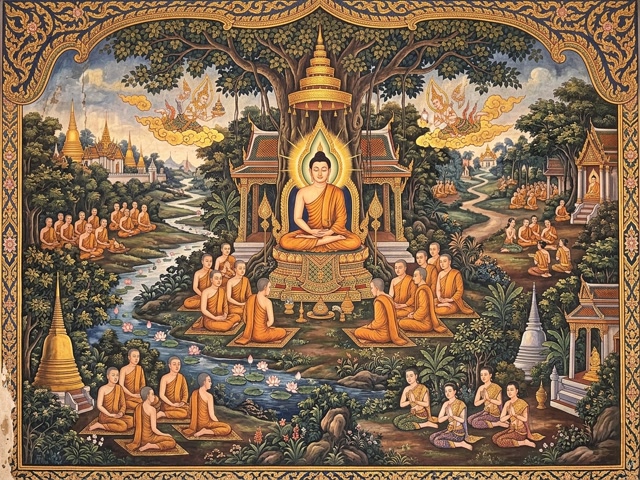
The Sutta Piṭaka: Expounding the Four Foundations of Mindfulness and the direct experiential path beneath the Bodhi tree.
If the Vinaya is the protective fence surrounding the garden of Dhamma, the Sutta Piṭaka is the flourishing garden itself. Comprising thousands of recorded dialogues, poems, doctrinal sermons, and psychological instructions delivered across forty-five years of the Buddha’s active teaching career, the Sutta Piṭaka embodies the heart of Buddhist philosophy and meditative praxis.
Unlike the technical micro-analysis of the Abhidhamma, the Suttas are expounded using conventional language (vohāra-desanā). The Buddha adapted his tone, metaphors, and instructional depth to match the spiritual temperament (carita) and latent capacities of his listeners—whether addressing wandering ascetics, haughty kings, humble farmers, grieving mothers, or intellectual brāhmaṇas. The Sutta Piṭaka is structured into five massive collections known as Nikāyas:
- Dīgha Nikāya (The Collection of Long Discourses): Containing 34 extensive suttas, this collection addresses profound philosophical debates, statecraft, and the cosmic dimensions of the Dhamma. Masterpieces include the Brahmajāla Sutta (The Supreme Net), which dismantles sixty-two speculative philosophical views regarding self and cosmos; the Sāmaññaphala Sutta (The Fruits of the Recluse Life), illustrating the progressive stages of mental refinement from basic morality to the six higher knowledges (abhiññā); and the Mahāsatipaṭṭhāna Sutta, the celebrated master blueprint detailing the Four Foundations of Mindfulness.
- Majjhima Nikāya (The Collection of Middle-Length Discourses): Comprising 152 dialogues of unparalleled psychological insight and dramatic narrative power, the Majjhima Nikāya is universally recognized as the essential handbook for serious meditators. Within its pages are the Ānāpānasati Sutta (Mindfulness of Breathing across sixteen sequential steps), the Sabbāsava Sutta (Methods for Eradicating Mental Defilements), the Alagaddūpama Sutta (The Simile of the Water Snake, warning against grasping Dhamma dogmatically), and the Mūlapariyāya Sutta (The Root Sequence of Perception).
- Saṃyutta Nikāya (The Connected Discourses): Organized systematically into 56 themed chapters (Saṃyuttas) encompassing 7,762 shorter discourses, this collection serves as a definitive topical encyclopedia. Key sections include the Khandha Saṃyutta (exhaustive investigations into the five aggregates of clinging), the Saḷāyatana Saṃyutta (the workings of the six internal and external sense bases), the Nidāna Saṃyutta (the definitive analysis of Dependent Origination / Paṭiccasamuppāda), and the Sacca Saṃyutta (the mechanics of the Four Noble Truths).
- Aṅguttara Nikāya (The Numerical Discourses): A brilliant feat of ancient pedagogical organization, this collection groups thousands of concise teachings into eleven numerical divisions (“The Book of the Ones” through “The Book of the Elevens”). It is renowned for its practical wisdom addressing daily ethics, householder finance, marital harmony, right livelihood, and gradual mental development, making it beloved by lay devotees worldwide.
- Khuddaka Nikāya (The Minor Collection): Despite its title, the Khuddaka is actually the largest and most culturally pervasive collection, containing fifteen (in Burma, eighteen) independent poetic and doctrinal classics. It houses the Dhammapada (The Path of Dhamma verses), the sublime archaic verses of the Sutta Nipāta, the Udāna (Exclamations of Joy), the Itivuttaka (The “As It Was Said” teachings), the deeply moving spiritual memoirs of the Theragāthā and Therīgāthā (Verses of the Elder Monks and Nuns), and the beloved Jātaka tales illustrating the Bodhisatta’s perfection of virtues across countless prior lifetimes.
In the realm of meditation, the Sutta Piṭaka provides the indispensable operational manual for both Samatha (calm abiding) and Vipassanā (insight). By illuminating how awareness must be anchored upon the body (kāyānupassanā), feelings (vedanānupassanā), mental states (cittānupassanā), and mental phenomena (dhammānupassanā), the discourses guide the practitioner from the confusion of everyday distraction into the radiant clarity of unshakeable liberation.
The Third Basket: The Abhidhamma Piṭaka (The Basket of Ultimate Realities)
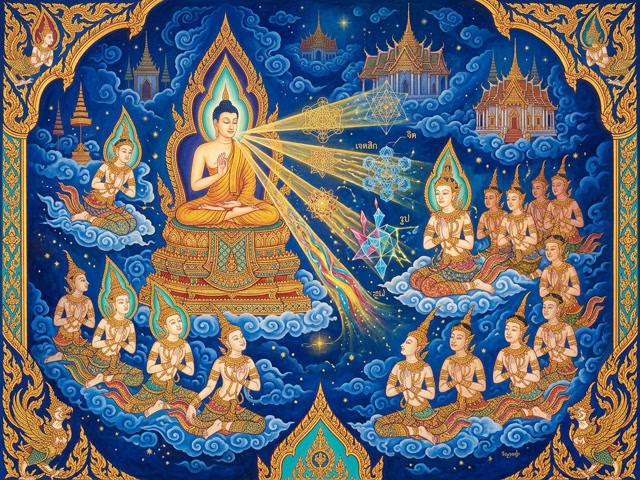
The Abhidhamma Piṭaka: Deconstructing phenomenal existence into Citta, Cetasika, Rūpa, and the unconditioned peace of Nibbāna.
The Abhidhamma Piṭaka represents the pinnacle of Buddhist scholastic psychology, metaphysics, and epistemological deconstruction. The prefix abhi denotes “higher,” “special,” or “transcendent.” Where the Sutta Piṭaka speaks in conventional terminology (vohāra-sacca)—referring to “beings,” “men,” “women,” “monks,” and “trees”—the Abhidhamma entirely strips away conventional designations, describing the cosmos exclusively through the lens of ultimate realities (paramattha-sacca).
In the Theravāda tradition, it is believed that the Buddha taught the Abhidhamma in the Tāvatiṃsa celestial realm to his deceased mother (reborn as a deva) and the assembled celestial host, repeating the condensed essence daily to his chief disciple, the Venerable Sāriputta, who subsequently expanded and structured it for the earthly Sangha.
The entire Abhidhamma architecture rests upon the rigorous dissection of all existing reality into Four Ultimate Realities (Paramattha Dhamma):
- 1. Citta (Consciousness): The bare knowing or awareness of an object. The Abhidhamma maps 89 (or 121 in expanded transcendental analysis) distinct classes of consciousness, categorized by plane of existence (kāma-loka, rūpa-loka, arūpa-loka, and lokuttara) and ethical quality (wholesome/kusala, unwholesome/akusala, resultant/vipāka, and functional/kiriya).
- 2. Cetasika (Mental Concomitants / Factors): The 52 mental qualities that arise and dissolve concurrently with consciousness, sharing its object and physical base. These include 7 universals (sabbacittasādhāraṇa, present in every moment of awareness, such as contact, feeling, and volition), 6 particulars (pakiṇṇaka), 14 unwholesome factors (such as delusion, greed, hatred, envy, and agitation), and 25 beautiful factors (sobhana, such as mindfulness, loving-kindness, wisdom, and tranquility).
- 3. Rūpa (Matter / Materiality): The physical basis of existence, consisting of 28 material phenomena divided into the 4 Great Essentials (Mahābhūta: earth/solidity, water/cohesion, fire/temperature, and air/motion) and 24 derived materialities (Upādā-rūpa, including the five physical sense organs, gender qualities, vitality, and physical nutritional essence).
- 4. Nibbāna (The Unconditioned): The single unconditioned reality (asaṅkhata-dhātu). Unlike the first three realities, which are compounded, conditioned, impermanent, and subject to rise and fall, Nibbāna is the cessation of all craving, the extinguishing of the fires of greed, hatred, and delusion, and the unconstructed state of total freedom.
The Abhidhamma Piṭaka consists of seven profound canonical treatises:
- Dhammasaṅgaṇī (Classification of Dhammas): An exhaustive taxonomy and ethical matrix of all states of consciousness and mental factors.
- Vibhaṅga (The Book of Treatises): Eighteen independent treatises analyzing central doctrinal formulas (aggregates, sense bases, truths, dependent origination) from both sutta and abhidhamma perspectives.
- Dhātukathā (Discourse on Elements): An advanced catechism examining the relationships, inclusions, and exclusions among the aggregates, bases, and elements.
- Puggalapaññatti (Designation of Human Types): A classification of human personalities according to spiritual maturity and behavioral tendencies, serving as an Abhidhammic bridge back to the suttas.
- Kathāvatthu (Points of Controversy): Authored by the Venerable Moggaliputtatissa Mahāthera during the Third Buddhist Council under Emperor Ashoka (c. 250 BCE), this polemical masterwork logically refutes 218 heretical propositions that had threatened to fracture the early Sangha.
- Yamaka (The Book of Pairs): A treatise of applied formal logic employing paired questions and contrapositions to eliminate ambiguities regarding the definitions and operational bounds of psychological terms.
- Paṭṭhāna (The Book of Conditional Relations): Regarded as the undisputed magnum opus of the Buddhist canon. Spanning several massive printed volumes, the Paṭṭhāna elucidates the cosmic web of causality through Twenty-Four Conditional Relations (Paccaya)—such as Root Condition (Hetu-paccaya), Dominance Condition (Adhipati-paccaya), Contiguity Condition (Anantara-paccaya), and Karma Condition (Kamma-paccaya). It proves that nothing arises from a single cause or by random accident; every event is the dynamically balanced convergence of intricate causal tributaries.
For the advanced Vipassanā meditator, the Abhidhamma is not mere intellectual gymnastics. When meditative concentration deepens, the conceptual illusion of a singular “person” or enduring “soul” collapses. The meditator directly experiences the ultra-rapid flicker of consciousness-units (citta-vīthi), seeing directly that what was once called “myself” is merely an unbroken, lightning-fast succession of psycho-physical processes arising and vanishing in obedience to impersonal universal laws. In this direct vision, anattā (non-self) is no longer a philosophical premise, but an undeniable sensory reality, triggering the decisive liberation of the mind.
The Tipiṭaka in Thai Buddhism and the Living Forest Tradition
Throughout the sacred geography of Thailand, the Tipiṭaka has historically been revered as the living body of the Buddha itself. Following the devastating destruction of the ancient capital of Ayutthaya in 1767, King Rama I made the restoration and purification of the Tipiṭaka the paramount spiritual priority of the newly founded Rattanakosin Kingdom. In 1788, he convened a grand council at Wat Mahathat Yuwaratrangsarit in Bangkok, bringing together 218 learned monks and 32 royal scholars to reconstruct the canonical texts from surviving palm-leaf bundles, creating the legendary golden-bordered Phra Trai Pidok Chabab Thong Yai.
Yet, nowhere has the spirit of the Tipiṭaka been more vividly verified than within the rugged ascetic hermitages of the Thai Forest Tradition (Kammāṭṭhāna), founded by Venerable Ajahn Mun Bhuridatto and exemplified by world-renowned masters such as Ajahn Chah Subhaddo of Wat Nong Pah Pong.
The Forest Masters continually remind us of the crucial tripartite relationship governing authentic Buddhist engagement:
- Pariyatti: The intellectual study and learning of the Tipiṭaka words.
- Paṭipatti: The direct experiential application of those words upon the meditation cushion and in the furnace of daily moral discipline.
- Paṭivedha: The direct penetrative realization of the fruits of liberation (Magga, Phala, and Nibbāna).
As Ajahn Chah frequently stated, one may study all eighty-four thousand verses of the Tipiṭaka, memorize the seven books of the Abhidhamma, and recite the entire Pātimokkha without fault, yet if one fails to turn the mind inward to examine the source of greed, aversion, and delusion in this very chest, the true Tipiṭaka remains entirely unopened. The external scriptures preserved on palm leaf and paper are but a signpost; the true Tipiṭaka is written upon the living heart.
Conclusion
The Tipiṭaka stands as humanity’s most comprehensive, unbroken, and logically cohesive repository of spiritual psychology and ethical philosophy. In the Vinaya Piṭaka, it provides the pure ground of ethical conduct; in the Sutta Piṭaka, it provides the warm, compassionate light of guided spiritual practice; and in the Abhidhamma Piṭaka, it provides the crystal-clear analytical diamond that cuts away the deepest delusions of selfhood. Whether approached by the academic historian, the devout lay devotee, or the solitary Vipassanā meditator seated beneath the canopy of the forest, the Three Baskets offer a complete, sufficient, and peerless vehicle across the ocean of saṃsāra to the sorrowless peace of Nibbāna.
— Authored by Ajarn Spencer Littlewood & (Citation and link-back required)
[Academic & Lineage Citation Notice: Citation Needed] All translations from the Pāḷi Canon (Tipiṭaka), commentary citations (Aṭṭhakathā), and Thai Forest Vipassanā hermeneutics presented in this treatise adhere to classical Theravāda canonical preservation standards. Independent scholarly verification and cross-referencing against the Pāḷi Text Society (PTS) recensions, the Royal Thai Chulachomklao Tipiṭaka edition (Rama V, 1893), and the Sixth Buddhist Council (Chaṭṭha Saṅgāyana) recension are warmly encouraged. Appropriate academic attribution and citation required for formal quotation, institutional research, or derivative broadcast composition.
