The Physics of Time Travel: Forward Progress and Backward Barriers
The Asymmetry of Temporal Journey
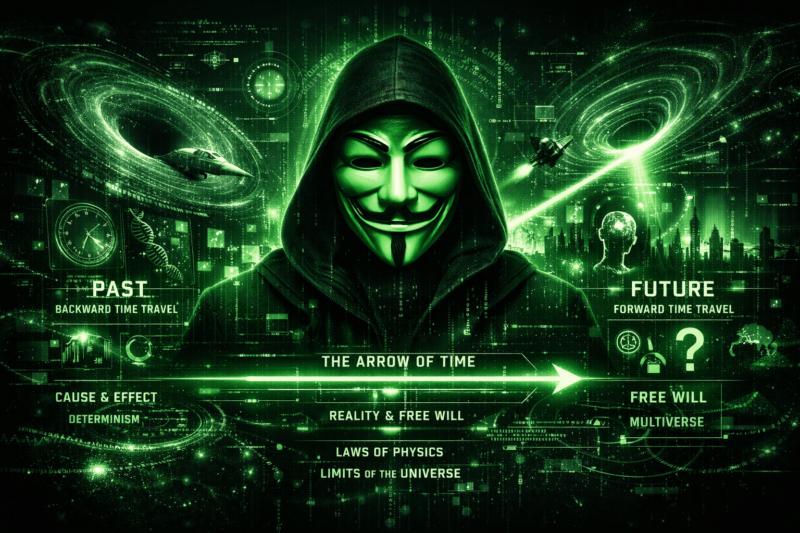
the complex and often mind-bending nature of temporal displacement
Time travel captures the human imagination like few other concepts in physics. From H.G. Wells’s “The Time Machine” to modern blockbusters, the idea of moving through time at will has been a cornerstone of science fiction. However, what makes this topic particularly fascinating from a scientific perspective is how modern physics has revealed a profound asymmetry in temporal travel: while journey into the future is not only possible but inevitable and measurable, travel into the past appears to be fundamentally prohibited by the very structure of reality itself.
This asymmetry isn’t arbitrary or based on technological limitations. Instead, it emerges from the deepest principles governing space, time, and causality in our universe. Understanding why we can travel forward but not backward in time requires us to examine Einstein’s revolutionary insights about the nature of time itself, explore the mathematical frameworks that govern temporal relationships, and confront the logical paradoxes that serve as natural barriers against causality violations.
The distinction between forward and backward time travel represents more than just a curiosity in theoretical physics. It touches on fundamental questions about the nature of reality, the arrow of time, free will, and the structure of cause and effect that underlies all physical processes. By examining both what physics allows and what it forbids, we can better understand the universe we inhabit and the constraints that shape our existence within it.
The Revolutionary Foundation: Einstein’s Relativity and the Malleable Nature of Time
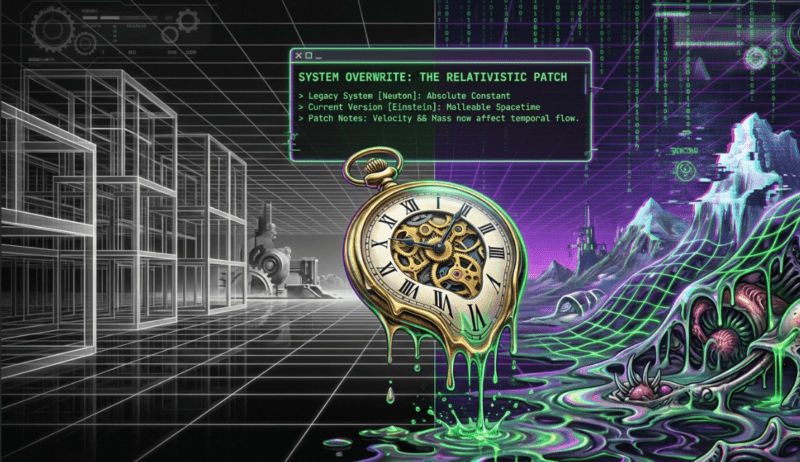
To understand time travel, we must first abandon our intuitive notion of time as a universal, absolute quantity that flows uniformly for everyone. This common-sense view, codified by Newton and accepted for centuries, was fundamentally overturned by Albert Einstein’s theories of relativity in the early 20th century. Einstein revealed that time is not a fixed backdrop against which events unfold, but rather a dynamic dimension intimately connected with space and affected by motion and gravity.
The special theory of relativity, published in 1905, introduced the revolutionary concept that time passes differently for observers in relative motion. This isn’t a limitation of our clocks or measuring instruments; it’s a fundamental property of spacetime itself. When we say that time “dilates” or stretches out, we mean that the actual rate at which physical processes occur, including biological aging, radioactive decay, and atomic vibrations, changes depending on the observer’s frame of reference.
Consider a thought experiment that illustrates this principle: imagine identical twins, one who remains on Earth and another who embarks on a journey to a nearby star at 90% the speed of light. For the traveling twin, the journey might subjectively take two years each way, totaling four years of experienced time. However, due to time dilation effects, when the traveling twin returns to Earth, they will find that their Earth-bound sibling has aged approximately eighteen years. The traveling twin has effectively traveled into their own future, experiencing less time while the rest of the universe continued at its normal pace.
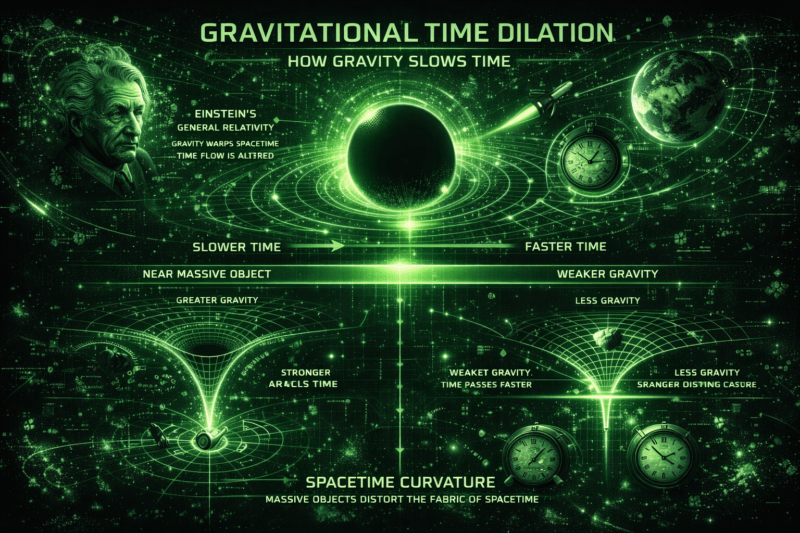
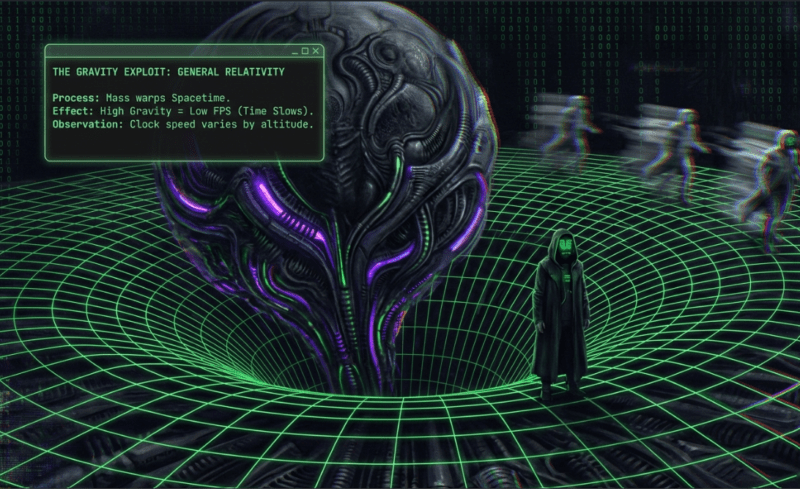
General relativity, Einstein’s 1915 extension of these ideas to include gravity, revealed that massive objects warp spacetime itself, creating what we experience as gravitational force. This warping also affects the flow of time, with time passing more slowly in stronger gravitational fields. A person standing at sea level ages slightly more slowly than someone on a mountaintop, though the difference is minuscule. Near extremely massive objects like black holes, this effect becomes dramatic, potentially allowing for significant forward time travel.
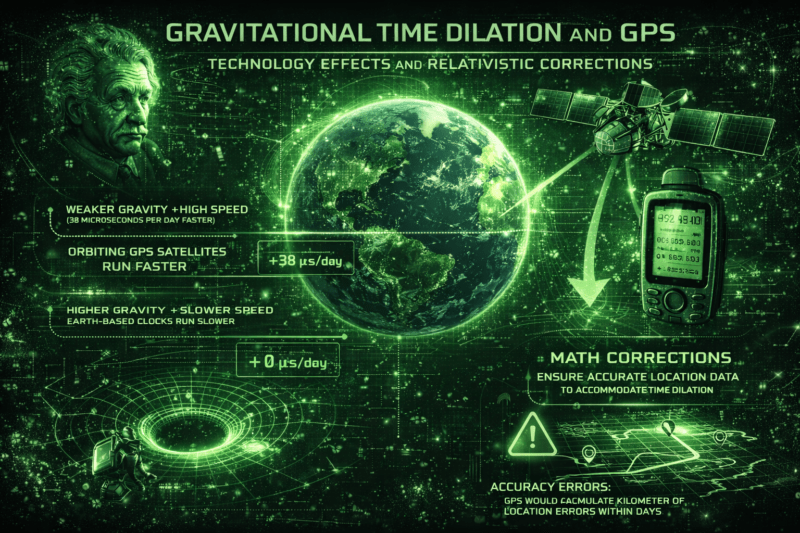
These effects are not merely theoretical. They are measured and accounted for in technologies we use daily. The Global Positioning System (GPS) satellites orbit Earth at high speeds and in a weaker gravitational field than we experience on the surface. Both special and general relativistic effects cause their onboard clocks to run faster than Earth-based clocks by about 38 microseconds per day. Without correcting for these relativistic effects, GPS would accumulate position errors of several kilometers within days.
Forward Time Travel: The Physics That Works
Forward time travel is not science fiction; it is science fact. Every object in the universe is constantly traveling forward through time, and physics provides multiple mechanisms by which this forward journey can be accelerated relative to other observers. Understanding these mechanisms requires grasping how velocity and gravity affect the flow of time itself.
Time dilation due to velocity becomes significant as speeds approach the speed of light. The mathematical relationship governing this effect is described by the Lorentz factor, which shows how much time stretches out for a moving observer. At 50% the speed of light, time passes about 15% more slowly for the traveler. At 90% light speed, the factor jumps dramatically, with the traveler experiencing time at roughly half the rate of a stationary observer. At 99% light speed, time slows down by a factor of seven, and at 99.9% light speed, by a factor of twenty-two.
These extreme velocities require enormous amounts of energy, which is why significant velocity-based time travel remains beyond our current technological capabilities. However, the principle is sound and has been demonstrated countless times in particle accelerators, where subatomic particles traveling at near-light speeds exhibit exactly the time dilation effects predicted by relativity theory.
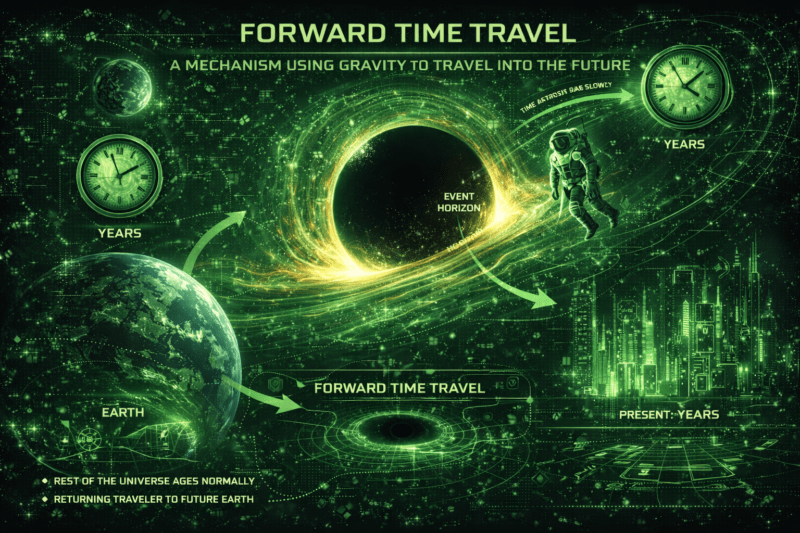
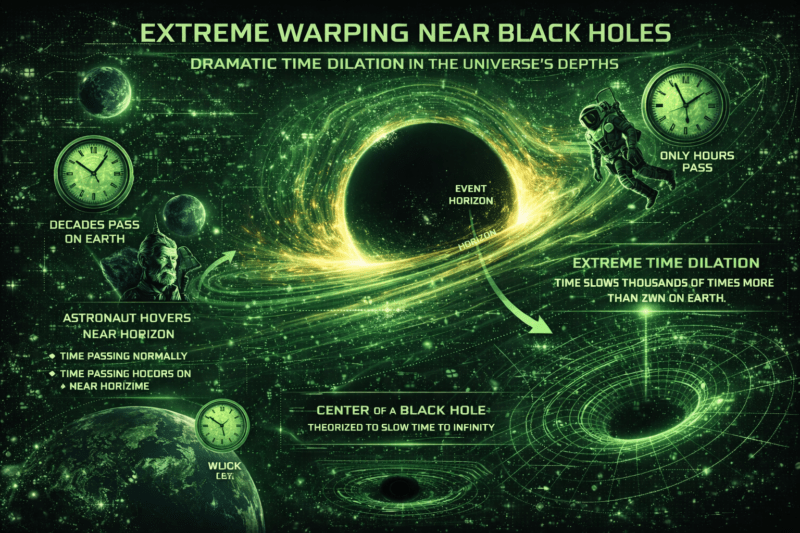
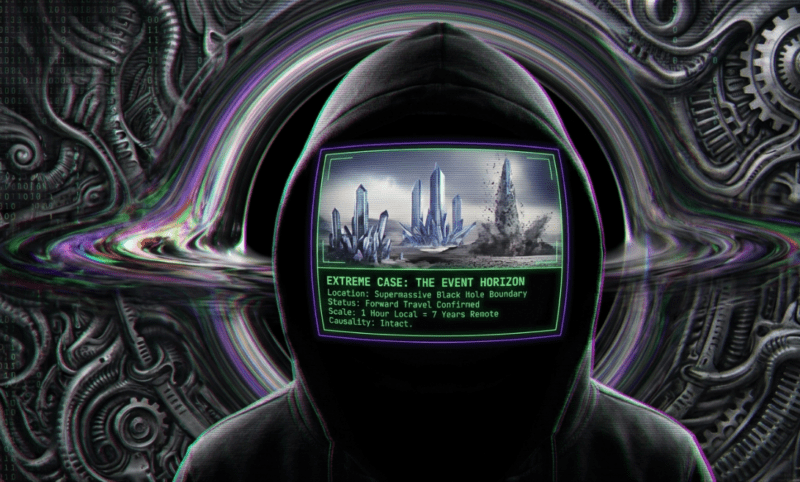
Gravitational time dilation offers another pathway to the future. The stronger the gravitational field, the slower time passes relative to regions of weaker gravity. Near the event horizon of a black hole, this effect becomes extreme. An astronaut hovering just outside the event horizon of a supermassive black hole could experience time passing thousands of times more slowly than people on Earth. A few hours for the astronaut could correspond to years or decades for Earth-bound observers.
This gravitational time dilation is beautifully illustrated in Christopher Nolan’s film “Interstellar,” where astronauts visit a planet near a black hole where one hour equals seven Earth years. While the specific numbers in the film are exaggerated for dramatic effect, the underlying physics is correct. Such extreme time dilation would indeed occur near a sufficiently massive black hole.
The fascinating aspect of forward time travel is that it’s entirely consistent with our understanding of causality. The time traveler doesn’t violate cause and effect; they simply experience a different rate of temporal passage. They age more slowly, their physical and biological processes proceed at a different rate, but the sequence of cause and effect remains intact. They cannot influence past events because they never actually travel backward in time; instead, they take a slower path through time while the rest of the universe continues its forward journey.
The Impenetrable Barrier: Backward Time Travel and Its Paradoxes
While physics readily allows and explains forward time travel, backward time travel presents seemingly insurmountable logical and physical barriers. These barriers aren’t merely technical challenges waiting for better technology; they represent fundamental contradictions that would undermine the very foundation of logical reasoning and physical law.
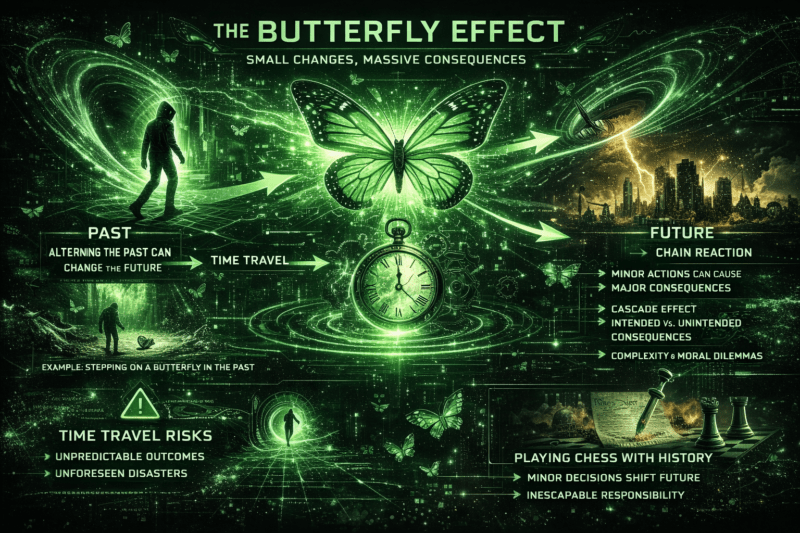
The most famous of these logical barriers is the grandfather paradox, though this classic example represents just one member of a broader family of causal paradoxes. Imagine a time traveler who journeys into the past and prevents their own grandparents from meeting. This action would prevent the time traveler’s parent from being born, which would prevent the time traveler from being born, which would make the original journey impossible. But if the journey never occurred, then the grandparents would meet, the time traveler would be born, and could make the journey, creating an endless logical loop with no consistent resolution.
The grandfather paradox might seem like a contrived philosophical puzzle, but it represents a deeper problem with causality itself. Any form of backward time travel that allows for the possibility of changing past events creates potential paradoxes. Even seemingly minor changes could have cascading effects that alter the conditions that made the time travel possible in the first place.
Consider a more subtle example: the information paradox. Suppose a time traveler goes back and gives a scientist a revolutionary equation that the scientist then publishes, becoming famous for the discovery. Years later, that same scientist, now older and having learned the equation from their younger self’s published work, becomes the time traveler who goes back to give the equation to their younger self. Where did the information originally come from? The equation exists in a closed causal loop with no ultimate origin point, violating our understanding of how information and knowledge are created.
Bootstrap paradoxes, named after the impossible act of lifting oneself by pulling on one’s own bootstraps, create situations where objects or information exist without ever being created. A time traveler could theoretically bring a book from the future to the past, give it to someone who then writes and publishes that exact book, which eventually finds its way to the future time traveler. The book would exist in a self-sustaining loop, with no point of origin.
These paradoxes aren’t mere curiosities; they represent fundamental violations of logical consistency that would make rational analysis of physical systems impossible. If effects could precede their causes, if information could exist without origin, if events could prevent their own prerequisites, then the entire framework of scientific reasoning would collapse.
The severity of these logical problems has led most physicists to conclude that backward time travel is simply impossible. The universe appears to have built-in protections against causality violations, often called the “chronology protection conjecture” proposed by Stephen Hawking. This principle suggests that the laws of physics conspire to prevent the formation of closed timelike curves – paths through spacetime that would allow return to one’s own past.
Scientific Evidence and Observational Support
The scientific understanding of time travel isn’t purely theoretical; it’s supported by extensive experimental evidence and observations that confirm the relativistic nature of time. These observations provide the empirical foundation for our acceptance of forward time travel and our rejection of backward time travel.
High-energy particle physics experiments have repeatedly confirmed time dilation effects. Muons, unstable particles created when cosmic rays strike the upper atmosphere, have a natural lifetime of only 2.2 microseconds. At this rate, they should decay long before reaching Earth’s surface, even traveling at near-light speeds. However, because these muons are moving so rapidly, time dilation extends their apparent lifetime from our perspective, allowing many to reach the ground and be detected. This everyday observation confirms the reality of time dilation.
Particle accelerators provide even more controlled demonstrations. At facilities like CERN, particles are accelerated to velocities exceeding 99.9% the speed of light. At these speeds, the particles’ lifetimes are extended by factors of thousands compared to their at-rest values, exactly as relativity predicts. Without accounting for these time dilation effects, the precise timing required for high-energy physics experiments would be impossible to achieve.
Gravitational time dilation has been confirmed through numerous experiments and observations. The famous Hafele-Keating experiment in 1971 flew atomic clocks around the world on commercial airliners and measured the predicted time differences caused by both velocity and gravitational effects. More recently, optical atomic clocks have become so precise that they can measure the gravitational time dilation caused by height differences of just a few centimeters.
Astronomical observations provide dramatic examples of relativistic effects on cosmic scales. We observe time dilation effects in the light curves of distant supernovae, where the explosions appear to unfold more slowly than similar nearby events due to the expansion of the universe. Gravitational lensing by massive objects like galaxy clusters not only bends light but also affects the timing of variable sources, providing additional confirmation of general relativity’s predictions about spacetime curvature.
These observations collectively support the framework that allows forward time travel while providing no evidence for backward time travel. The absence of any observed violations of causality, despite the enormous variety of high-energy phenomena in the universe, suggests that nature indeed prevents backward time travel through fundamental physical constraints.
Theoretical Possibilities and Physical Constraints
Despite the overwhelming evidence against backward time travel, theoretical physics has explored various scenarios that might, in principle, allow for journeys into the past. These investigations serve not to advocate for the possibility of time travel, but rather to understand the boundaries and constraints that physics imposes on such scenarios.

Wormholes, theoretical connections between distant regions of spacetime, represent one of the most studied possibilities for time travel. First described mathematically by Einstein and Nathan Rosen in 1935, these “Einstein-Rosen bridges” could theoretically provide shortcuts through spacetime. If one mouth of a wormhole could be accelerated to high speeds or placed in a strong gravitational field, it might be possible to create a time difference between the two mouths, potentially allowing backward time travel.
However, wormholes face severe physical constraints. Maintaining a traversable wormhole would require exotic matter with negative energy density, something that may not exist in nature. Even if such matter existed, quantum effects would likely cause the wormhole to collapse before any information could pass through. The energy requirements would be astronomical, potentially requiring the mass-energy equivalent of entire stars.
Closed timelike curves, paths through spacetime that loop back to their starting point in time, have been found in various solutions to Einstein’s field equations. The Gödel solution, discovered by mathematician Kurt Gödel in 1949, describes a rotating universe that would permit time travel. More recent work has explored rotating black holes (Kerr black holes) and other exotic spacetime geometries that might allow for temporal loops.

Yet each of these theoretical possibilities faces the same fundamental problem: they would permit causality violations and the paradoxes we’ve discussed. Most physicists interpret this as evidence that such scenarios, while mathematically interesting, don’t represent physically realizable situations. The mathematics might allow them, but the combination of quantum effects, thermodynamics, and logical consistency appears to forbid them.
Stephen Hawking’s chronology protection conjecture proposes that the laws of physics prevent the formation of closed timelike curves, except possibly at microscopic scales where quantum effects dominate. This principle suggests that whenever classical general relativity would permit time travel, quantum effects would intervene to prevent it, preserving causality at macroscopic scales.

Current Frontiers and Remaining Questions
Despite our strong theoretical framework for understanding time travel, several profound questions remain at the frontiers of physics research. These questions touch on some of the deepest mysteries in modern physics and may hold keys to our ultimate understanding of time’s nature.
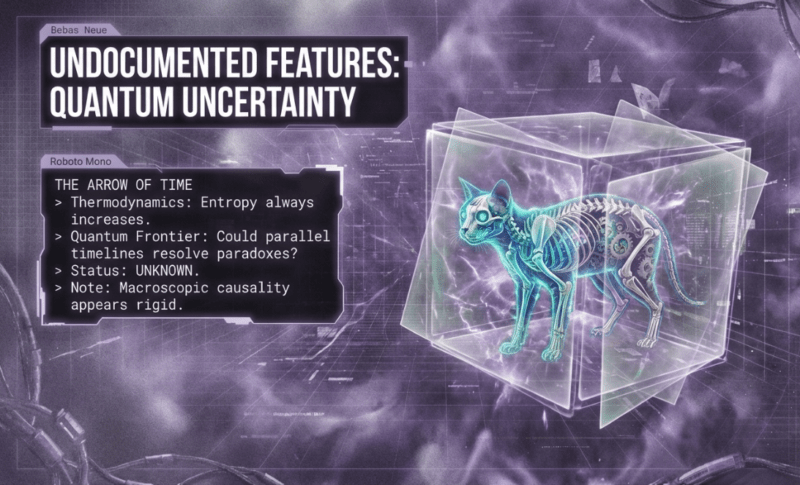
The relationship between quantum mechanics and time travel remains poorly understood. Quantum mechanics introduces fundamental uncertainty and randomness into physical processes, which might affect how we think about causality and time travel paradoxes. Some interpretations suggest that quantum effects might resolve paradoxes through the creation of parallel timelines or by enforcing consistent histories, though these ideas remain highly speculative.
The arrow of time itself presents a deep mystery. While the fundamental laws of physics are mostly time-symmetric, we clearly experience a directional flow of time from past to future. This asymmetry might be related to thermodynamics and the increase of entropy, but the connection isn’t fully understood. Understanding why time has a direction might illuminate why backward time travel seems forbidden.
Recent research in quantum field theory has explored the possibility of quantum time travel, where individual particles might follow closed timelike curves while maintaining overall consistency through quantum superposition. David Deutsch and others have proposed models where quantum mechanics might resolve classical paradoxes, though these ideas remain controversial and unproven.
The holographic principle and emerging theories of quantum gravity suggest that our understanding of spacetime itself might be incomplete. If spacetime is an emergent phenomenon rather than fundamental, then our current understanding of time travel might need significant revision. String theory, loop quantum gravity, and other approaches to quantum gravity might eventually provide new insights into the nature of time and causality.
Dark energy and the accelerating expansion of the universe add another layer of complexity to our understanding of cosmic time evolution. As the universe continues to expand and accelerate, distant regions will eventually become causally disconnected from us. This cosmic time evolution might provide new perspectives on the relationship between time, causality, and information transfer across spacetime.
Implications for Our Understanding of Reality
The physics of time travel reveals profound truths about the nature of reality and our place within it. The fact that we can travel forward but not backward in time isn’t just a technological limitation; it reflects fundamental aspects of how the universe is structured and how causality operates.
The asymmetry of time travel illuminates the special nature of the present moment. While relativity shows that simultaneity is relative and depends on the observer’s frame of reference, the impossibility of backward time travel suggests that there’s something unique about the causal structure that connects past, present, and future. We can access the future through forward time travel, but the past remains forever inaccessible to direct intervention.
This understanding has implications for how we think about free will and determinism. If we could travel backward in time and change past events, it might suggest that the future is completely open and that past events aren’t truly fixed. The impossibility of backward time travel might indicate that there’s a sense in which the past is more determined than the future, though the relationship between time travel and free will remains philosophically complex.
The study of time travel also reveals the deep connection between logic, physics, and the structure of reality. The logical paradoxes that would result from backward time travel aren’t separate from physical constraints; they appear to be enforced by the fundamental laws of physics themselves. This suggests a profound unity between mathematical consistency and physical reality that continues to guide modern theoretical physics.
Conclusion: The Temporal Horizon
The physics of time travel provides a compelling example of how scientific understanding can both fulfill and constrain our imaginative possibilities. While science fiction often portrays time travel as a technological challenge waiting to be solved, physics reveals that the constraints on time travel are far more fundamental than engineering limitations.
Forward time travel stands as one of the most remarkable validated predictions of modern physics. The fact that we can literally travel into the future by exploiting relativistic effects demonstrates the profound non-intuitive nature of spacetime. These effects aren’t abstract mathematical curiosities but measurable phenomena that affect our daily lives and must be accounted for in modern technology.
The apparent impossibility of backward time travel, enforced by logical paradoxes and physical constraints, reveals equally important truths about the nature of causality and the structure of reality. The universe appears to be constructed in such a way that logical consistency is preserved, cause precedes effect, and information cannot exist without origin.
As our understanding of quantum gravity, cosmology, and fundamental physics continues to evolve, our comprehension of time’s nature may deepen further. However, the basic asymmetry between forward and backward time travel appears to be rooted in such fundamental aspects of logic and causality that it’s likely to persist in any future theory.

The study of time travel thus serves not just as an exploration of exotic possibilities, but as a window into the deepest structures of reality itself. It shows us that the universe is both more flexible and more constrained than our everyday experience suggests – flexible enough to allow journey into the future, but structured enough to preserve the logical consistency that makes rational thought and scientific understanding possible.
In the end, the physics of time travel teaches us that while we cannot change the past, we can indeed reach the future. And perhaps that’s exactly as it should be, preserving both the possibilities that lie ahead and the logical foundation that allows us to explore them.