When working in Antigravity CLI (agy v1.5.18), developers frequently hit an expensive dilemma: a lightweight execution model moves fast and preserves rolling quotas, yet makes brittle architectural mistakes on multi-file changes; a flagship reasoning model gets the architecture right, yet burns through 5-hour and 7-day rate limits while performing mechanical edits, package updates, and test retries. The Gemini 4 Neon Orchestrator (gemini-pro-orchestrator-neon) resolves that tension inside a single conversation turn.
Introduced alongside the November 2026 Gemini 4 Neon release and refined through Antigravity CLI v1.5.14 to v1.5.18, Orchestrator is not a crude prompt classifier that guesses one model upfront and leaves you stuck with it. Instead, it operates a two-phase, two-model state machine sharing a unified conversation history—pairing Neon’s architectural judgment and low fabrication rate with Gemini 4 Hydrogen’s high-velocity execution. Used properly, it cuts quota drain substantially while accelerating turn completion; misconfigured or applied to the wrong workload, it silently doubles context overhead or stalls halfway through large builds.
1. Under the Hood: The Two-Phase State Machine
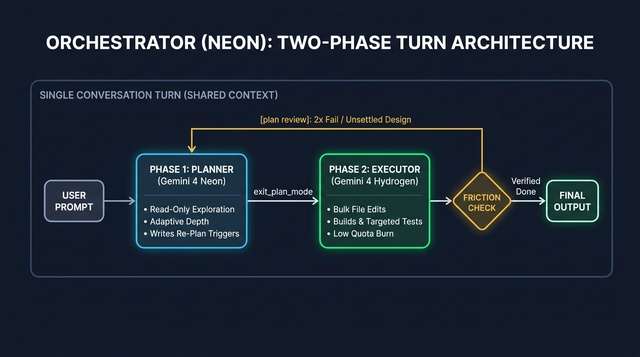
Official Antigravity model architecture documentation defines Orchestrator as an in-turn collaboration loop between a Planner (Orchestrator Model) and an Executor Model. In Gemini 4 Neon, the Planner brings a 512K-token context window, #1 ranking on the Artificial Analysis Coding Agent Index, and a reported 32% lower cost per task than Gemini 4 Carbon at its default High thinking level. Every prompt submitted while Orchestrator (Neon) is active transitions through three deterministic stages:
- Stage 1 — Read-Only Planning Phase (Gemini 4 Neon): Every turn begins in read-only planning mode. Neon adapts its investigation depth to the prompt: pure diagnostic questions, code reviews, or conceptual explanations requiring no workspace edits are answered directly by Neon without waking the Executor. Settled minor follow-ups (fixing a typo, re-running a verified command, applying an already-approved edit) skip deep search and hand off a one- or two-sentence plan immediately. Complex multi-file requests trigger read-only file inspection and search, culminating in an explicit implementation plan complete with target file paths, verification commands, and “Re-plan if:” boundary triggers before Neon invokes
exit_plan_mode. - Stage 2 — High-Velocity Execution Phase (Gemini 4 Hydrogen): Once
exit_plan_modetransfers the plan, Gemini 4 Hydrogen executes inside the exact same turn and shared context. Hydrogen writes code, applies file diffs, runs builds, and executes targeted tests—shifting repetitive edit-and-verify loops off frontier reasoning quotas and onto fast, lightweight execution pools. - Stage 3 — Automatic Friction Escalation & Progress Review (
[plan review]): Control automatically reverts to Neon whenever Hydrogen hits unexpected friction—specifically if a verification step fails twice, an API or UI behaves differently than anticipated, an unsettled architectural choice arises, a periodic long-task checkpoint triggers, or the operator sends a mid-turn steering message. Neon inspects the live state, repairs the plan, and hands control back to Hydrogen without requiring manual model switching.
2. Live CLI Controls in Antigravity CLI v1.5.14–v1.5.18
Several online summaries still describe early Orchestrator releases where planner and executor effort were locked globally. Checking the live local agy 1.5.18 runtime and recent release notes reveals four critical controls every operator should know:
Verified CLI v1.5.18 Mechanics
- Model Identifier: Run
agy modelsto verifygemini-pro-orchestrator-neon(Orchestrator (Neon)), alongsidegemini-pro-orchestrator(Carbon) andgemini-pro-orchestrator-argon(scheduled for Argon/3.8 Flash deprecation on November 30, 2026). - Per-Role Sliders Inside
/model(v1.5.14+): Highlight Orchestrator inside/modeland pressTaborShift+Tabto jump across Planner, Executor, and each role’s independent Effort slider (←/→). Selections persist under"orchestrator"in~/.gemini/antigravity-cli/settings.json. HighDefault Effort Cap (v1.5.15+): Both Planner and Executor now default tohighrather thanxhighormax, eliminating silent over-thinking on standard tasks.- Smart Same-Model Collapse (
v1.5.17+): Setting the exact same model and same effort for both Planner and Executor bypasses two-phase handoff and runs single-agent directly (inheriting cleanly in/btwand/context). Selecting distinct effort tiers of the same family (such asNeon HighPlanner +Neon LowExecutor) preserves two-phase plan-and-execute review. - Why
/effortReports Disabled: Top-level/effortand--effortflags do not govern Orchestrator because role budgets are split; tune them inside/modelinstead. On Gemini Enterprise accounts,gemini-pro-orchestratorremains fixed at Carbon (High) + Hydrogen (High).
Tech Talks Audio Episode — Gemini 4 Neon Orchestrator Deep Dive
British UK Broadcast Narration synthesized with Google Gemini 3.8 Flash TTS (en-gb-training-1) and Tech Talks synth intro/outro soundscape.
3. Choosing the Right Tool: Standalone Orchestrator vs. /goal, /swarm, /teamwork & run_workflow
Understanding what Orchestrator (Neon) does well—and where its architecture hits hard boundaries—prevents wasted runs. On its own, Orchestrator excels at single-thread, multi-step features, refactors, and debugging. However, standalone Orchestrator is not optimal for massive one-shot start-to-finish application builds or multi-stage parallel pipelines for three architectural reasons:
- Single Agent, Single Context Window: Both Neon and Hydrogen operate sequentially inside one conversation thread. On massive builds, every file read and compiler log remains in that shared window until compaction, increasing latency and per-turn token cost.
- Normal Turn-Stopping Behavior: Without
/goal, the agent yields control back to the terminal as soon as it considers the current step answered—often pausing after partial milestones rather than driving autonomously from zero to verified production. - No Native Worker Parallelism: Orchestrator alternates one thread at a time; it does not fan out concurrently across independent modules or execute deterministic Python pipeline stages unless explicitly paired with Antigravity’s multi-agent tools.
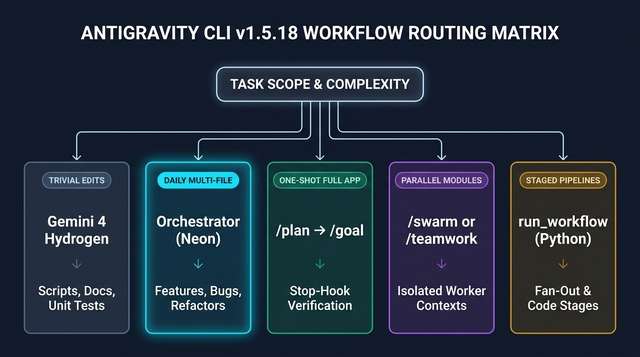
| Engineering Scenario | Optimal CLI Setup | Why This Pairing Wins |
|---|---|---|
| Trivial edits, boilerplate, package bumps, quick docs, settled unit tests | Gemini 4 Hydrogen (low / medium) |
Eliminates planning overhead entirely; fastest response time and lowest quota consumption. |
| Daily multi-file features, bug triage, API wiring, medium refactors | Orchestrator (Neon) (Neon High + Hydrogen Medium/High) |
Frontier upfront architecture and automatic recovery on failures while delegating edits cheaply to Hydrogen. |
| Subtle refactors where Hydrogen overlooks tight invariants | Orchestrator (Neon High Planner + Neon Low Executor) |
Keeps two-phase review active (v1.5.17+) with Neon’s low fabrication rate on edits at Low effort cost. |
| Deep novel distributed systems, concurrency races, massive repo migrations | Orchestrator (Carbon) or standalone gemini-4-neon-xhigh |
Allocates maximum deliberation budget across every intermediate dependency without rushing edits. |
| Unattended one-shot start-to-finish app build (single repo) | /plan → /goal on Orchestrator (Neon) |
/plan locks the design first; /goal hooks every stop attempt until real builds and tests pass, while Hydrogen keeps loops lean. |
| Large multi-module apps or multi-day builds | /teamwork (paid plans) or /swarm |
Isolates modules into fresh worker contexts; /teamwork adds clean milestone context resets plus Critic, Challenger, and Success Auditor gates. |
| Deterministic multi-stage pipelines (fan-out, cross-checking, aggregation) | run_workflow (invoked from Orchestrator) |
Python agent, parallel, pipeline, and phase primitives run isolated stage contexts instead of polluting one thread. |
4. Five Optimal Production Workflow Recipes
Maximize engineering throughput while minimizing token consumption by structuring prompts with file pointers (@), narrow test flags, and deliberate mode pairing:
Workflow A: Daily Multi-File Feature & Surgical Fix
Stay on Gemini 4 Hydrogen for trivial tasks and invoke Orchestrator only for heavy turns—or launch an interactive session directly on Neon Orchestrator. Always pass @ path mentions (which pass references rather than pasting entire files) and specify the exact verification command:
# Launch Orchestrator (Neon) for the current session without altering saved defaults
agy --model gemini-pro-orchestrator-neon

# Or borrow Orchestrator for a single turn from a Hydrogen session:
/model gemini-pro-orchestrator-neon @src/auth/jwt.ts @tests/auth.test.ts Fix the token rotation race condition and verify ONLY with `npx vitest run tests/auth.test.ts --bail`.
Workflow B: Unattended Start-to-Finish App Build (/plan → /goal)
When you need an entire single-codebase service built end-to-end without stopping prematurely, separate architecture approval from autonomous execution. First run /plan to lock schemas and file boundaries; once approved, switch to /goal so Antigravity’s stop hooks force real compiler and test verification before finishing:
# Step 1: Lock architecture cleanly in read-only planning
/plan Build a FastAPI + SQLite telemetry collector for Raspberry Pi nodes in @services/telemetry with pytest coverage and a systemd unit.

# Step 2: Compact exploration noise, then execute autonomously until verified
/compact Keep only the approved schema, file layout, and test requirements.
/goal Implement the telemetry collector from the approved plan. Do not stop until `ruff check`, `pytest -x --tb=short`, and live curl health checks on port 8090 all pass.
Workflow C: Precision Refactoring Without Hydrogen Drift
When refactoring tricky parsers, concurrency locks, or protocol state machines where Hydrogen tends to drop subtle edge cases, open /model, highlight Orchestrator, and use Tab + arrow keys to configure Planner: Neon (High) and Executor: Neon (Low). Because the two roles have different thinking efforts, Antigravity CLI v1.5.17+ retains two-phase plan-and-execute while cutting implementation reasoning burn dramatically.
Workflow D: Parallel Fan-Out & Multi-Stage Workflows
Whenever a job decomposes into five or more independent modules, let Neon Orchestrator act as coordinator over isolated worker contexts instead of loading every file into one thread:
# Multi-module build with independent verification board
/swarm Audit and patch security headers across services/auth, services/billing, services/media, and services/gateway in parallel, then run integration smoke tests.

# Multi-day or milestone-gated enterprise build
/teamwork Build the complete multi-tenant booking portal with separate frontend, backend, database migration, and Playwright verification milestones.
Workflow E: Headless CI/CD & Automated Audits
In non-interactive pipelines, combine -p (--print), --model gemini-pro-orchestrator-neon, and --output-format json for deterministic machine-readable outputs with built-in planning and verification:
agy -p "Audit the staged git diff for SQL injection or unvalidated inputs, patch any defects, and run pytest tests/security/ --tb=short" --model gemini-pro-orchestrator-neon --output-format json5. Context Hygiene & Quota Economics: Saving Tokens on Every Turn
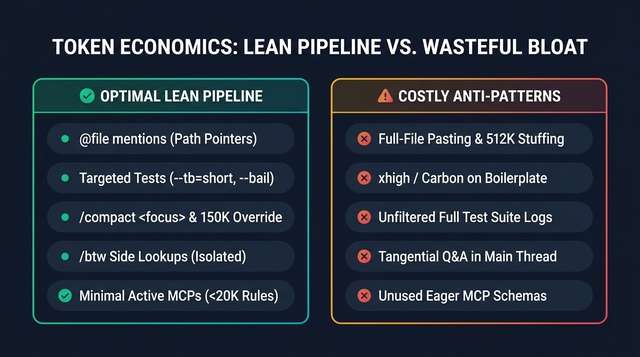
Because Antigravity re-sends the active conversation history on every Planner turn, Executor turn, and [plan review] escalation, keeping an extra 100K tokens of stale terminal logs in history multiplies quota burn across the entire session. Pair Neon Orchestrator with these five context-hygiene habits:
- Inspect Live Usage with
/context: Run/contextto see the proportional token grid broken down by User messages, Agent responses, Tool calls, Rules, Skills, MCP tools, and Checkpoint buffer. - Compact Between Milestones (
/compact <focus>): Immediately after codebase exploration finishes—or after each completed feature milestone—run/compact Keep the modified paths, API contracts, and failing test names; now implement step 3to shrink history into a clean checkpoint without ending your workflow. - Cap Context Growth with
AGY_CLI_AUTO_COMPACT_OVERRIDE(v1.5.15+): Override the automatic compaction threshold well below Neon’s 512K limit so quadratic token cost never snowballs:# PowerShell cap at 150K tokens (also accepts "35%" or "0.2M") $env:AGY_CLI_AUTO_COMPACT_OVERRIDE = "150K" agy --model gemini-pro-orchestrator-neon - Offload Side Lookups to
/btw(v1.5.15+): Need to check a port number, regex rule, or config path mid-build? Run/btw What port does redis bind in docker-compose.yml?. Inv1.5.15+,/btwinherits your Orchestrator configuration, executes read-only tools in a temporary card, and never adds those file reads to your main conversation history. - Trim Overhead & Dead Ends: Press
Escimmediately if the agent heads down a dead end and run/rewindto erase failed turns. Use/mcpto disable unused MCP servers (avoiding"eager": trueunless needed every turn), keep always-on rules well under Antigravity’s 20,000-token auto-demotion ceiling, use/forkfor speculative experiments, and run/clearwhen switching to an unrelated project.
6. Six Costly Misconfigurations & Anti-Patterns (With Case Studies)
Just as proper configuration amplifies productivity, misconfiguring Orchestrator—or choosing it for tasks that violate its single-thread design—can drain weekly quotas rapidly while producing worse results. Avoid these six real-world traps:
Anti-Pattern 1 — Over-Specifying Carbon or xhigh on Routine Tasks: Manually sliding both Orchestrator roles to Carbon / xhigh (or bypassing Orchestrator to run standalone gemini-4-neon-xhigh) for CSS tweaks, dependency bumps, or CRUD boilerplate forces deep reasoning chains on problems with obvious answers. Result: Massive weekly quota exhaustion for zero accuracy gain. Fix: Leave Orchestrator at its v1.5.15+ default (Neon High + Hydrogen High/Medium), or switch to standalone Hydrogen for trivial edits.
Anti-Pattern 2 — Running a Massive One-Shot App Build in a Single Orchestrator Thread: Typing “Build a complete 25-file SaaS dashboard with auth, Stripe billing, and E2E tests” into standalone Orchestrator without /plan → /goal, /swarm, or /teamwork causes two failures: the agent stops halfway after finishing step one, or accumulates 350K+ tokens of stale file snapshots in one context window, slowing down every turn and triggering premature compaction loss. Fix: Use /plan then /goal for single-repo unattended builds, or /teamwork / /swarm / run_workflow to isolate modules into clean contexts.
Anti-Pattern 3 — Unfiltered Full Test Suite & Build Log Flooding: Instructing Orchestrator to run bare npm test or verbose pytest -vv on a 1,200-test repo floods Tool calls with tens of thousands of passing lines. On the very next friction escalation, Neon must re-read that entire passing log wall. Fix: Always pass targeted paths and fail-fast flags (--bail, -x --tb=short, -q).
Anti-Pattern 4 — Expecting --effort to Control Orchestrator or Misusing Same-Model Collapse: Passing agy --model gemini-pro-orchestrator-neon --effort low has no effect because CLI --effort does not alter Orchestrator’s split roles. Conversely, setting both Planner and Executor inside /model to Neon (High) silently triggers v1.5.17 Smart Same-Model Collapse—disabling the two-phase plan/review gate you thought was active. Fix: Verify role pairing in /model and ensure distinct models or distinct effort levels whenever two-phase review is desired.
Anti-Pattern 5 — Unused "eager": true MCP Servers & Bloated Rules: Leaving five heavy MCP servers marked "eager": true injects full JSON parameter schemas into every Planner and Executor request—even when never called. Similarly, exceeding Antigravity’s 20,000-token always-on rule budget causes large rule files to demote unpredictably. Fix: Audit /context and /mcp, turn off idle servers, and extract specialized workflows into on-demand Skills.
Anti-Pattern 6 — Asking Tangential Questions Inside the Main Build Thread: Pausing a delicate backend refactor to ask in the main prompt how a Docker volume or NGINX header is configured pulls unrelated files into the active working set, diluting model attention. Fix: Prefix tangential read-only queries with /btw so they stay isolated outside main history.
7. Quick-Reference Cheat Sheet
| Command / Variable | Purpose |
|---|---|
agy --model gemini-pro-orchestrator-neon |
Start session using Gemini 4 Neon Planner + Gemini 4 Hydrogen Executor. |
/model (then Tab / ← / →) |
Independently configure Orchestrator Planner, Executor, and per-role Effort sliders. |
/context |
Inspect token distribution across history, tool calls, rules, skills, and MCP tools. |
/compact <focus> |
Summarize earlier turns into a lean checkpoint and continue in the same turn. |
AGY_CLI_AUTO_COMPACT_OVERRIDE="150K" |
Cap active context size before automatic compaction triggers (accepts tokens, K/M, or %). |
/btw <question> |
Run read-only side lookups without polluting main conversation context. |
/plan → /goal |
Lock design upfront, then enforce stop-hook verification for unattended full builds. |
/swarm / /teamwork / run_workflow |
Split parallel modules, milestone handoffs, or multi-stage Python workflows into isolated contexts. |
When integrated into a disciplined local engineering stack—such as running alongside local GPU compute on an ASUS Ascent GX10 DGX workstation under structured agentic rules—Gemini 4 Neon Orchestrator delivers frontier planning precision at lightweight execution cost. Treat context like RAM, delegate repetitive implementation to Hydrogen, escalate large parallel work to /swarm or /teamwork, and every rolling quota window goes dramatically further.
Selected Publications and Monographs


— Authored by Ajarn Spencer Littlewood & Agent Gemini Unleashed for www.ajarnspencer.com